
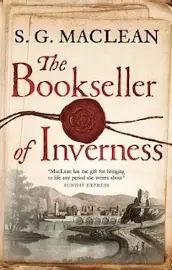
386 pages – Historical Crime – Standalone
4 Minute Review Read
Why I Read This Book
I’m actually finding this quite hard to remember, as I think I first read this book when I was around 11. Although I can’t quite remember this, apparently my Granddad gave the book to my Dad, and as I read every book in the house I could get my hands on, that copy has been mine to this day. It has become a kind of comfort book, and I think this most recent read of it was about the 5th. There is so much I love about this book – the characters, the setting, the plot, the research behind it… Basically this review will just be me going on (in a constructive way) about all the great things I adore about it!
The Book
The book starts in Inverness in 1752, six years after the battle of Culloden. Iain Bàn MacGillivray is recently returned from deportation in Virginia, like many other Jacobites who were spared execution. The main setting, Inverness, is perfectly researched and vividly comes to life around you. If you’ve ever been to Inverness town centre, you know that Iain’s shop is just a short walk down Church Street away, his grandmothers house just further along, and which direction to walk to get to the old tolbooth (jail for small offences) over the hill.
But the avid research doesn’t just apply to geography – S. G. brilliantly captures the dynamics of the relationships between Jacobites and Redcoats in the years after most of the atrocities ended. It’s not England versus Scotland, or even Redcoat versus Jacobite some of the time. Some Redcoats tried to prevent the unnecessary violence, and so got looked upon with respect in Jacobite groups. So some members of the Hanoverian army were well looked upon in Jacobite families and communities, while those that decided to cause pain and fear were hardly tolerated.
I found interactions the main character has with certain Redcoats very interesting and impactful as well. A good friend of Iain’s was a Hanoverian, and they both fought in Culloden – despite being friends before and after, they both know that they would have killed each other if the battle had called for it. Although these exact characters were obviously not real, that kind of thing most certainly did happen. The same is true for a lot of the character dynamics and stories that make up the sub-plots of this book. In the Author’s Note, she says that she used a copy of The Lyon in Mourning by John Forbes to create a lot of those stories, as that book is a compilation of first-hand accounts of the battle of Culloden and its aftermath. (I’m looking for that book in every charity shop and antique bookshop I can find.)
Throughout this book, the representation of Gaelic culture and tradition is spot-on, probably because the author lives locally and, like many of us, had the stories of Prince Charlie and the Jacobites as a fact of life. I can’t remember when I first heard the Syke Boat Song, or was told about the Battle of Drummossie Moor (aka The Battle of Culloden), they were just things that I always knew.
And, for the LPs part of my readership, in this book I absolutely loved the description of traditional music, and the freedom that can come in playing an instrument. I’ve heard it said that Scottish people, especially in the Highlands, can like all various genres, but we all can dance and connect to a good reel and a ceilidh rendition of Ramblin’ Rover or Johnnie Cope.
Johnnie Cope is in fact an infamous Jacobite song, which features memorably in the book – for a good idea of how it would have sounded when Iain performed it, I recommend The McCalmans’ or The Corries’ version. The lyrics are about the Battle of Prestonpans, when the Jacobites surprised a Hanoverian regiment and won the battle in 15 minutes thanks the officer Jonny Cope’s sleeping in!
Johnnie Cope by The McCalmans: https://open.spotify.com/track/2AOngOrlAOxU6rqtP2hrZv?si=65d4035e65d14e77
And by The Corries: https://open.spotify.com/track/6ZHJMxOnsysT6mdFNWnuuQ?si=689a15bfeb894697
Something that I had a love/hate relationship with in this book was the amount of hope, and loyalty, to what we know is a lost cause. Most of the characters are still ready to lay down their lives for The Prince, some probably will, and yet we know that the Hanoverians remained in power – our king is a direct descendant. The fact that we know none of the other planned risings will ever take off, and that Scotland still feels like an unequal party in the union, makes reading about fictional, though possible, personal experiences even more emotional.
Leave a Reply